

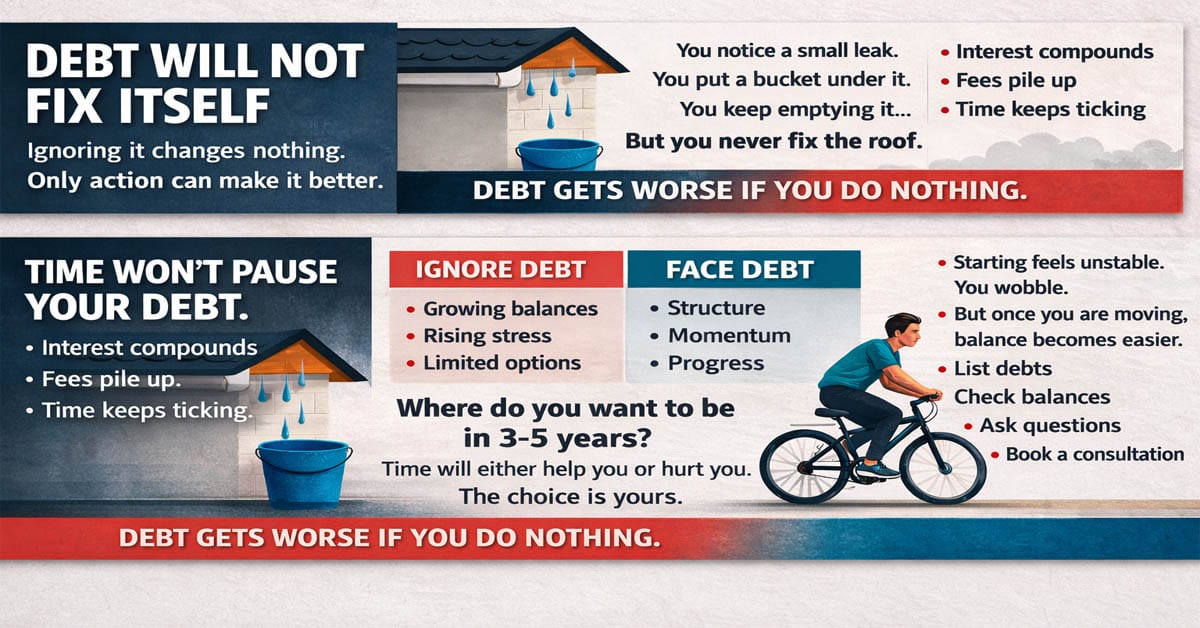
I sit with people every week who quietly hope things will just… ease up. That somehow, if they hold on a little longer, something will shift. So they stop opening statements. Or they skim them quickly and look away. They pay the minimum and tell themselves, “At least I’m not falling behind.” But then life happens. Fuel goes up again. Eskom throws your whole routine off. Food costs creep higher. And that small bit of breathing room you thought you had? Gone. Because debt doesn’t settle down on its own. It waits. Then it grows.
Think about a small leak in your roof. At first, it’s manageable. Annoying, sure, but not urgent. You put a bucket underneath and carry on. You tell yourself you’ll deal with it when things calm down. But things don’t calm down. Then the proper rain comes. The kind that keeps you awake at night. That small drip turns into something louder, heavier. The ceiling starts changing colour. You notice the smell. Now it’s not just a leak anymore. It’s damage.
Debt is like that. Quiet in the beginning. Easy to push aside. But it doesn’t stay small. Interest keeps ticking. Fees slip in. Months pass. And one day you look at the balance and feel that drop in your stomach. “How did it get this bad?”
2025 probably felt long while you were living it. Most years do. But now? It feels like it vanished. We’re already well into 2026. And if you’re honest with yourself… didn’t that happen a bit too quickly?
Life keeps moving whether you’re ready or not. Work, family, responsibilities. But your debt is moving too. Just in the background. Quietly building.
If you’re only paying the minimum, most of that payment isn’t even helping you get out. It’s just keeping things from getting worse… for now. That’s a hard place to be. Paying, but not progressing.
If nothing changes, nothing changes.
I know that sounds obvious. But when you’re under pressure, it’s easy to believe things might just turn around. In my experience helping clients here in South Africa, especially lately with how tight everything has become, debt doesn’t suddenly improve on its own. It follows patterns. If you’ve been going deeper, that trend usually continues. Not because you’ve done something wrong, but because the system is designed that way.
Credit fills the gap… until it becomes the problem. Hope feels comforting. But it doesn’t shift numbers.
Most people think their biggest problem is money. Sometimes it is. But more often, it’s that stuck feeling. You look at everything… the accounts, the balances, the calls… and it feels like too much. So you pause. You tell yourself you’ll deal with it when you feel more ready. But ready never really arrives, does it?
And the longer you wait, the heavier it all feels. Not just financially. Mentally too. I’ve seen how that weight sits on people. It’s not just numbers on a page. It follows you around.
Starting is uncomfortable. There’s no way around that. It’s like trying to ride a bike again after years. That first push feels shaky. You’re not sure if you’ll keep your balance.
But something interesting happens once you move. Even a little. You begin to steady.
Listing your debts. Looking at your balances properly. Asking a question you’ve been avoiding. Speaking to someone who understands the process.
These aren’t big dramatic steps. But they matter. They’re movement. And movement changes things.
When you’re inside the situation, everything feels urgent. Every message feels like bad news waiting. Every unknown feels bigger than it is. It’s exhausting.
That’s why an outside view can make such a difference. A debt counsellor doesn’t see chaos. We see structure. We know what can be done and what can’t. We know where to start.
Sometimes the biggest shift for someone is just hearing, calmly, “Alright… here’s the plan.” And for the first time in a while, things feel a bit lighter.
Time itself isn’t the problem. It’s what happens during that time.
Ignore your debt, and time quietly works against you. Face it, even slowly, and time starts working with you.
Same months. Same years. Different outcome.
A few years from now, you’ll look back at this period. The question is… what will you see? More pressure? Or the point where things finally started changing?
That small leak won’t fix itself. But it can be fixed. So can this.
You don’t need to have everything sorted out today. Just take one step. That’s usually where things begin to shift.